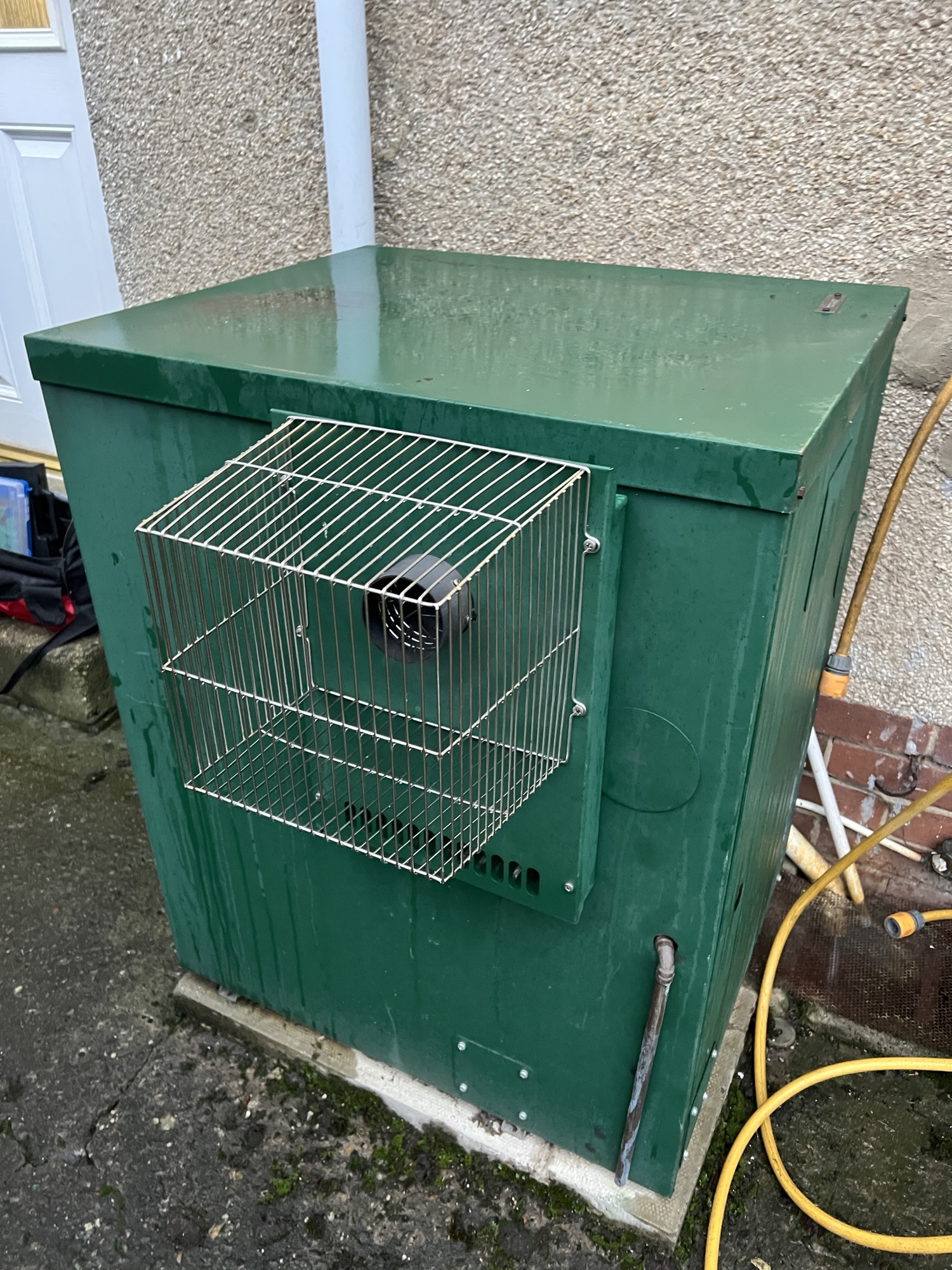
Does my external boiler need a flue guard? Any gas appliance with a flue lower than 2m from the ground needs a guard.

What is a flue guard?
A flue guard is a metal cage designed to surround the boiler flue terminal. It’s has three roles:
- Protect the user from the flue.
- Protect the flue from damage.
- Stop people (normally children) placing objects in the flue.
It is normally a metal cage screwed to the wall around the flue.
Why do I need a flue guard?
The British standard that covers installation of flues states a flue guard is required.
Also it is stated in the manufacturer instructions of every boiler that a flue guard is required.
What size do I need?
The flue guard needs to be big enough to cover the flue.
The guard must have clearances around it of 50mm from every part of the flue.
This gives enough space to stop fingers poking through the gaps to the hot flue.
What material should a flue guard be made of?
Flue guards are normally made of metal. Some are made of hard plastic but they are the exception.
The material has to be capable of:
- Protecting the flue from damage.
- Keeping fingers from touching the flue.
- Stopping objects being placed in the flue.
- Tolerating the heat from the boiler
- Surviving the steam and flue gases when the boiler is running.
Most flue guards are made of steel mesh.
For condensing boilers they are made of stainless steel m, hard plastic or plastic coated steel.
Standard unprotected steel flue guards will start to rust almost immediately if used on a condensing boiler.

What if I don’t have a flue guard?
Any new boiler that has a flue below 2m from the ground should have a guard.
New installation
A new install should not be signed off as complete without a flue guard. Contact your installer. They need to come back to install a guard if the flue is below 2 m from the ground.
Existing boiler
An existing boiler without a flue guard would be classed as not to current standards by a gas engineer.
You don’t have to correct the fault as it is not a gas safety defect.
However if a child burns their fingers on a hot flue you may wish you had.
Summary
A flue guard is required if the flue is below 2m from ground level.
A flue guard is required if it is accessible. For example you could reach the flue from a balcony.
If you found this confusing:
If you found this confusing. Please let us know in the comments section so we can clear things up for you. We love feedback and we are trying to make the best possible website. If you don’t understand then others don’t as well.
If you found this useful:
If you found this useful maybe check some of our other pages.
- My radiators are too hot
- Vaillant F28 fault
- Common causes of a Vaillant F75 fault
- Boiler pressure dropping
- E160 Fault on Baxi or Potterton Boiler
- Expansion vessel problems
- F1 low pressure fault on an Ideal Logic boiler
- Filling loop left open
- Do I need a powerflush?
- E50 fault
- Hello deary